View JupyterHub details
Use the service details page to find the URL that opens JupyterHub and to check the settings of the service.
Open the service details
- Select Data platform → Workspace management, then select your workspace.
- On the Overview tab, under Services, select JupyterHub.
The details page opens with JupyterHub: and the service name as its title, the Status and Created at of the service, and two tabs: Essential Information and Advanced. The Actions menu holds Delete. See Delete a JupyterHub service.
Essential Information tab
The Essential Information tab shows how to open JupyterHub and the settings of the service in three sections.
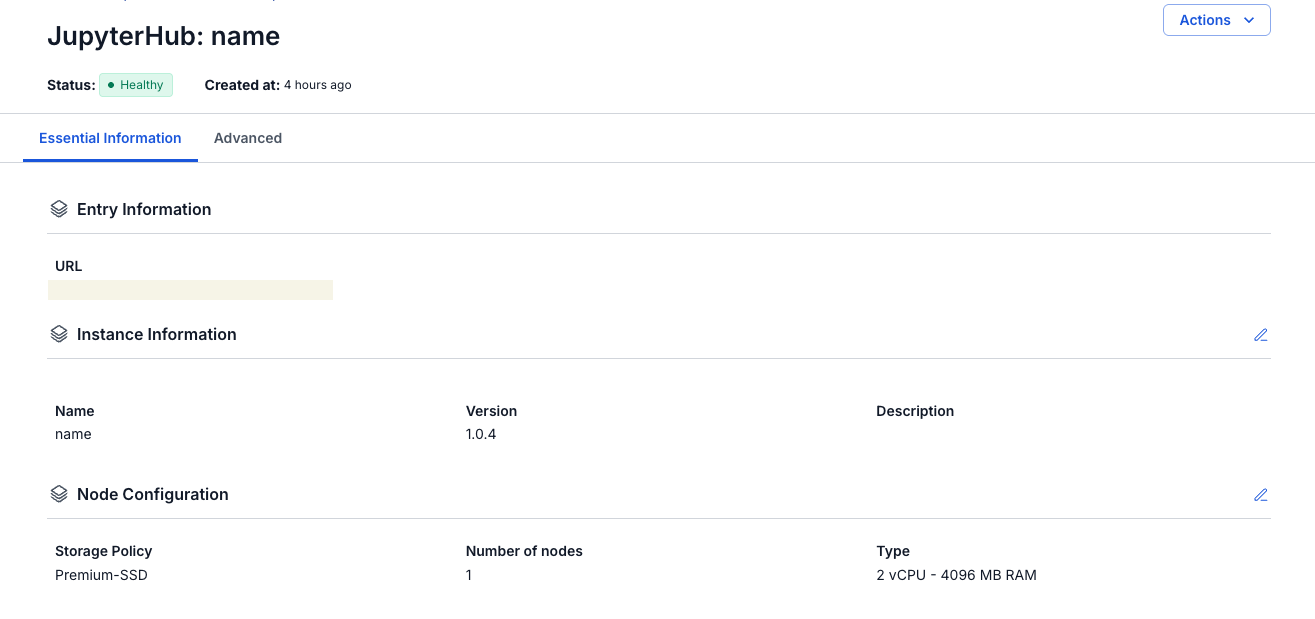
| Section | Fields |
|---|---|
| Entry Information | The URL that opens JupyterHub. |
| Instance Information | Name, Version, and Description of the service. |
| Node Configuration | Storage Policy, Number of nodes, and Type of the nodes, for example 2 vCPU - 4096 MB RAM. |
To open JupyterHub, go to the URL. With basic authentication, create the admin account the first time you open it. With single sign-on (SSO) through FPT ID, the URL opens a sign-in page with the Sign in with FPT-ID button. See Manage JupyterHub users.
Instance Information and Node Configuration each have an edit icon. Change the fields you need in the panel that opens, then select Save. To close the panel without saving changes, select Cancel.
| Edit icon of | Panel | Fields you can change |
|---|---|---|
| Instance Information | Update Basic Info | Name (1 to 30 characters, letters, numbers, and hyphens) and Description. |
| Node Configuration | Update Node Configuration | Storage Policy, Type, and Number of nodes (1 to 10). |
Advanced tab
The Advanced tab shows where JupyterHub stores user data, and its database, encryption, sign-in, and custom domain settings.
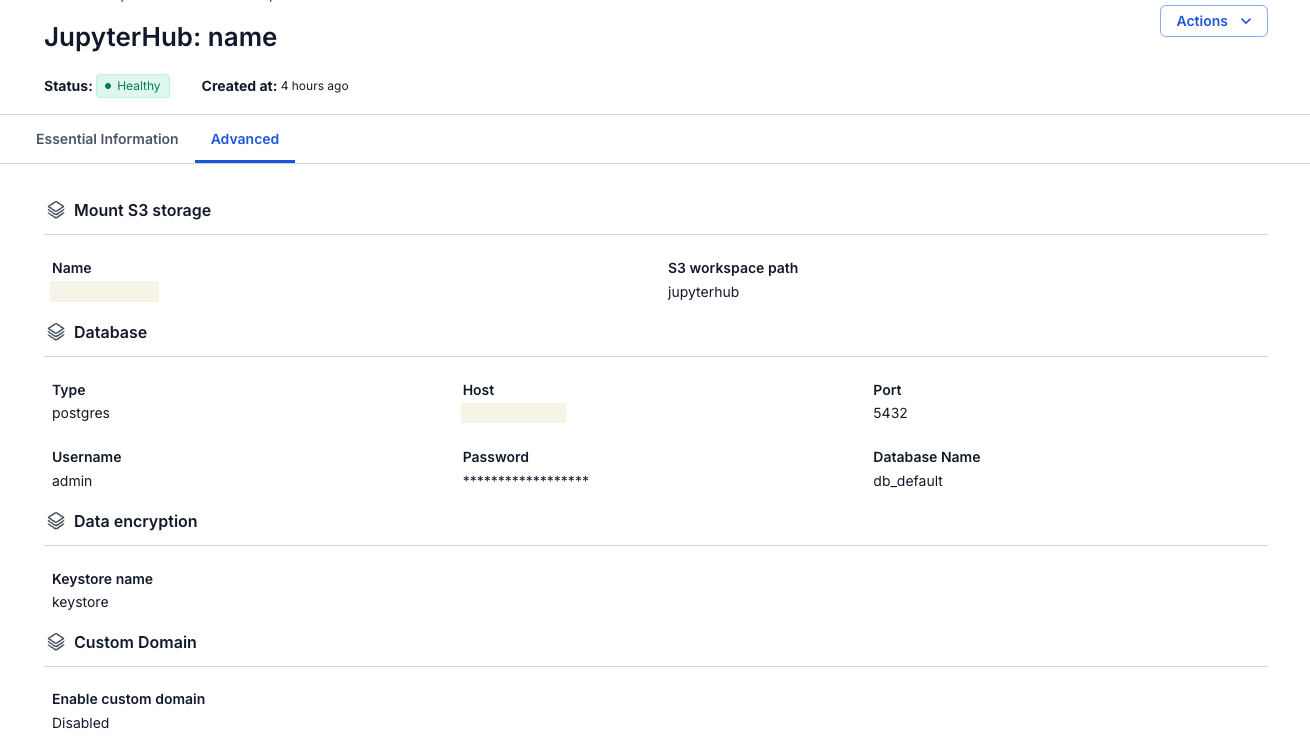
| Section | Fields |
|---|---|
| Mount S3 storage | Name of the storage and S3 workspace path of the user data. |
| Database | Type (postgres), Host, Port, Username, Password (masked), and Database Name of the PostgreSQL database. |
| Data encryption | Keystore name, the keystore that encrypts sensitive data. |
| Single Sign On | Type and Email. The section appears when the service uses single sign-on (SSO). |
| Custom Domain | Enable custom domain, which shows whether the service uses a custom domain. |
You manage profiles in JupyterHub itself, not on this tab. See Manage JupyterHub profiles.