Compare the structure of two snapshots
Comparing structure shows what changed in a table between two snapshots, such as added columns, a new partitioning, or a jump in the record count. It does not read the rows, so it is fast and a good first check before you compare data.
Prerequisites
- Your role includes
time_machine:metadata_diff. Theportal_admin,data_engineer, anddata_analystroles have it. - You can read the table in Data Security.
- The table has at least 2 snapshots.
Choose the order of the snapshots
You pick two snapshots: Snapshot A and Snapshot B. Time Machine treats A as "before" and B as "after", and calculates every change as B minus A. It does not sort them by time for you.
Pick the older snapshot as A and the newer one as B. If you swap them, the numbers are still right, but they read backwards. A table that grew by 500 records shows as -500.
Compare the structure
- Open the Time Machine tab of the table.
- Select the older snapshot in Snapshot A.
- Select the newer snapshot in Snapshot B. It must be different from A.
- Select Compare.
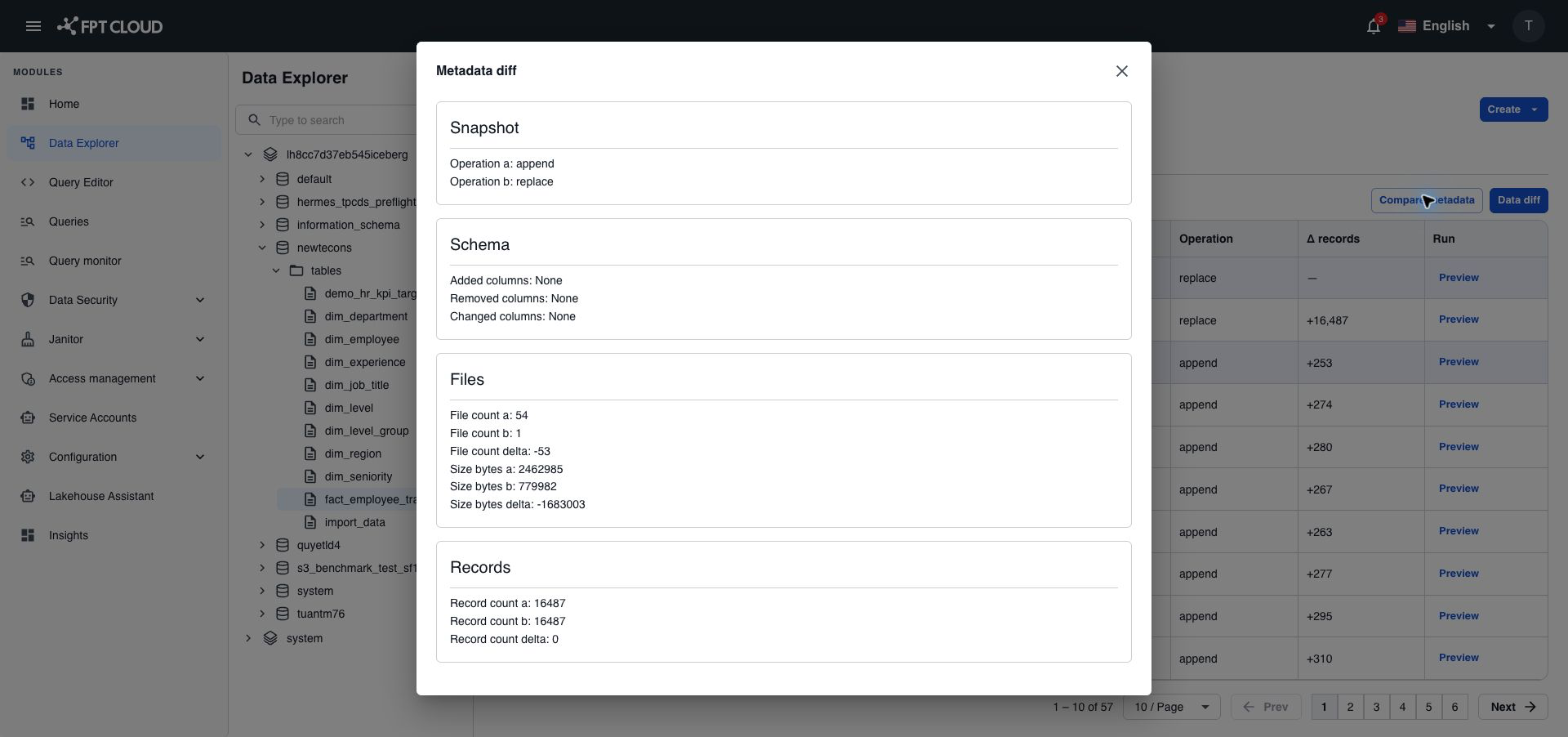
Read the result
The result has six sections.
| Section | What it compares |
|---|---|
| Snapshot | The two snapshots: ID, time, and kind of write. |
| Schema | Columns added, removed, or changed in type. |
| Partition | How the table is split into partitions. |
| Properties | The technical settings of the table. |
| Files | The number and size of data files. |
| Records | The number of records, and the change from A to B. |
A section can show Not available with a reason. For example, the partition layout of an old snapshot may no longer be stored. This is not an error. The other sections are still correct.
If something goes wrong
| Situation | What it means | What to do |
|---|---|---|
| The snapshot pair is not valid | You picked the same snapshot twice, or one of them does not exist. | Pick two different snapshots from the timeline. |
| Access denied | Your role or your data access does not allow it. | Ask your administrator for time_machine:metadata_diff or for access to the table. |