FPT API Gateway
FPT API Gateway is one of the core components of the FPT Integration Platform ecosystem. It acts as a centralized intermediary layer that manages, controls, and routes requests between clients and backend services, giving your APIs a single, unified access point so that communication is secure, consistent, and easy to scale.
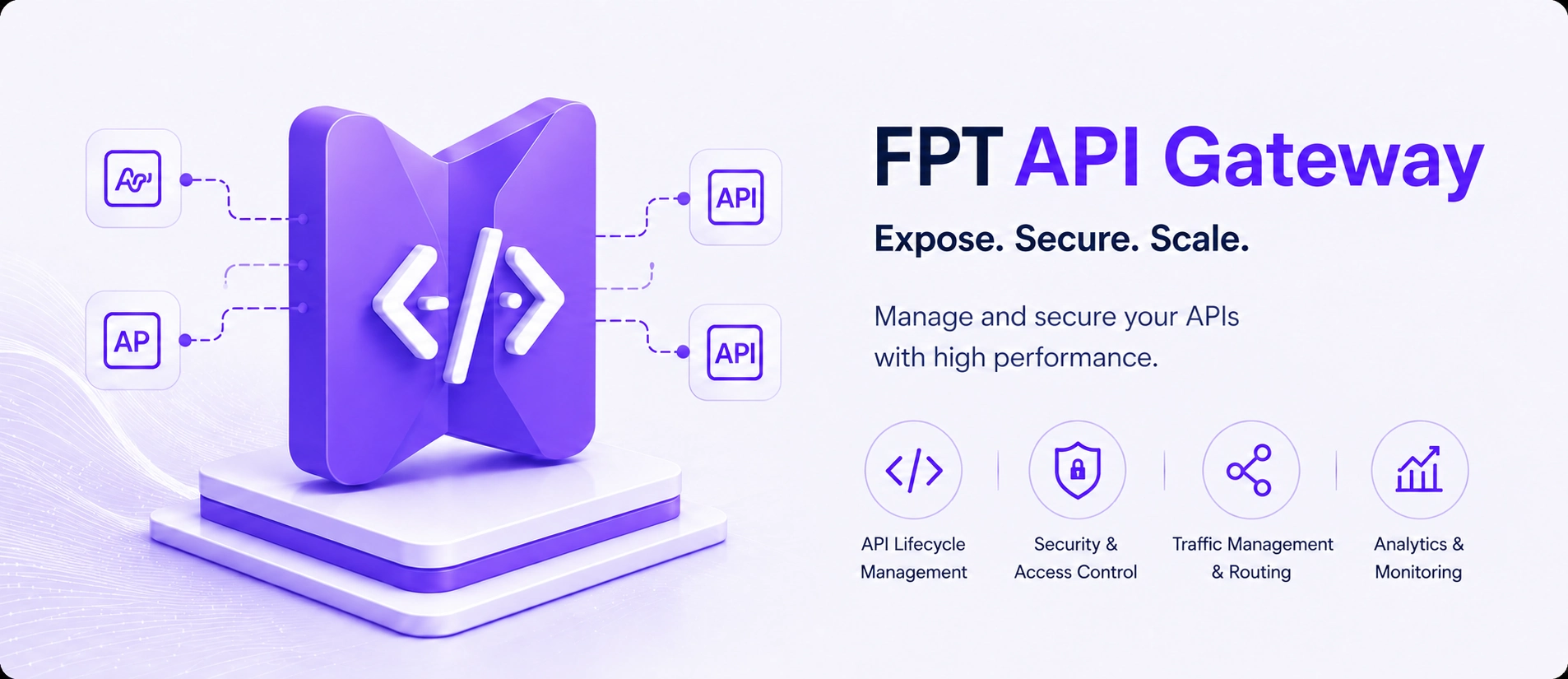
FPT API Gateway lets you manage multi-gateway instances from a single, centralized management console. It also supports core capabilities such as traffic routing, authentication, authorization, rate limiting, load balancing, monitoring, and API lifecycle management. You can visually configure and manage routes, services, upstreams, plugins, and TLS certificates, which simplifies system administration and operations.
API Gateway is especially well-suited for microservices architectures and distributed systems, strengthening security, control, and flexibility when you consume and operate APIs.
Key concepts
| Concept | What it is |
|---|---|
| API Gateway | A dedicated gateway cluster in your VPC on OpenStack. Every other resource belongs to one API Gateway. |
| Route | Matches incoming requests (path, method, host) and forwards them to a Service or an Upstream. |
| Service | Groups Routes that share one Upstream and the same plugins. |
| Upstream | The backend targets (host and port) that receive the traffic, with load balancing and health checks. |
| API Catalog | Imported OpenAPI specifications that you can turn into Routes and Upstreams. |
| Consumer | An application or user that calls your APIs, identified by its credentials (for example a JWT credential). |
| Plugin | Adds behavior such as authentication, rate limiting, CORS, or request rewriting, at the Global, Route, Service, or Consumer scope. |
| Certificate | An SSL/TLS certificate shared by the whole organization. |
| Custom domain | Your own domain, such as api.yourcompany.com, served by an API Gateway with a certificate. |
A request from a client reaches the API Gateway on its default domain or a custom domain, matches a Route, passes through the plugins in scope, and is forwarded through a Service or directly to an Upstream, which sends it to one of its targets.